Why GeM Is the Biggest Opportunity for Indian MSMEs Right Now
Launched in 2016, the Government e-Marketplace (GeM) has become the world's largest public procurement platform. In FY 2024–25 alone, GeM's Gross Merchandise Value (GMV) crossed ₹4.09 lakh crore — a 50% year-on-year growth.
For MSMEs, the numbers are even more compelling:
- Over 1.125 million MSMEs registered on GeM have secured orders totalling ₹7.44 lakh crore
- MSMEs account for nearly half of all procurement value on the platform
- MSME-only tenders are reserved for purchases up to ₹200 crores
- EMD (Earnest Money Deposit) exemption saves 1–2% per bid for Udyam-registered vendors
If your business is not on GeM in 2026, you are leaving a massive, government-guaranteed revenue stream on the table.
Who Can Register on GeM?
GeM is open to:
- Individual sellers and proprietorships
- MSMEs (Micro, Small, Medium) with Udyam Registration
- Private Limited and LLP companies
- Startups recognised by DPIIT
- OEMs (Original Equipment Manufacturers) and their authorised resellers
The basic eligibility requirements are: GST registration, PAN, and a valid bank account. MSME registration via Udyam is optional but strongly recommended — it unlocks exclusive benefits unavailable to non-MSME sellers.
Step-by-Step GeM Registration Guide (2025–26)
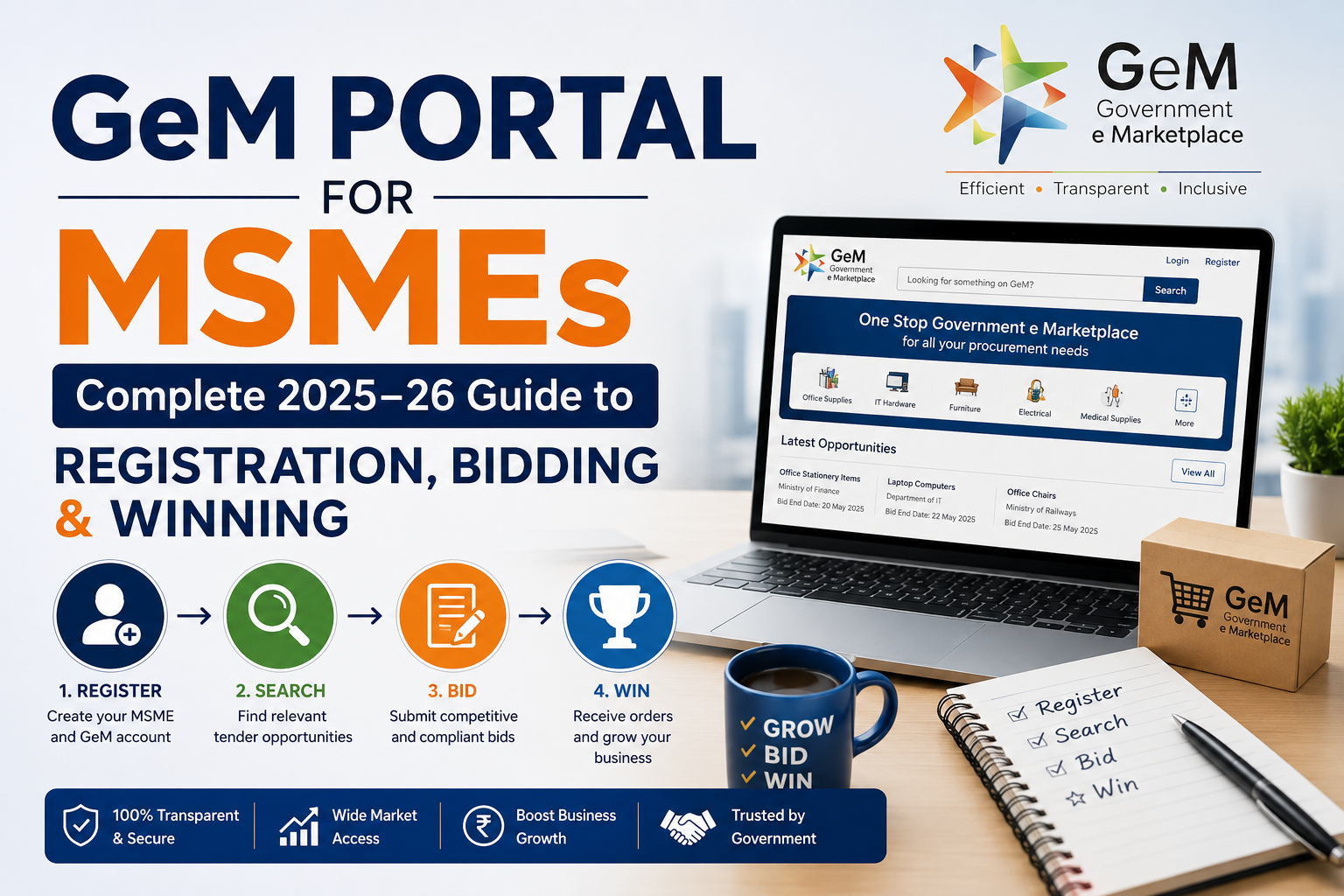
- Visit gem.gov.in and click 'Seller Registration'
- Enter your mobile number and Aadhaar-linked details for OTP verification
- Upload Udyam Certificate, PAN, GSTIN, and bank account details
- Complete KYC — verification typically completes within 48 hours
- Set up your seller profile to 100% completion (address, contact, business description)
- Add product/service catalogue with correct category classification codes
- Link DSC (Digital Signature Certificate) for tenders above ₹2 lakh
Critical Warning: Correct product categorisation is non-negotiable. Misclassification means your bid is automatically filtered out — government buyers search by category code, not keyword.
Types of Procurement on GeM
GeM operates through three main procurement modes:
- Direct Purchase — orders below ₹25,000 placed without bidding
- L1 Purchase — orders between ₹25,000 and ₹5 lakhs, lowest price wins
- Competitive Bidding / Tender — orders above ₹5 lakhs, full technical + financial evaluation
For serious revenue generation, competitive bidding is where you want to be. Contracts typically range from ₹5 lakhs to ₹50+ crores depending on category.
How to Find and Evaluate the Right GeM Tenders
Not all tenders are worth bidding. Here is how to identify high-probability opportunities:
- Use GeM's advanced search filters: category, state/location, bid value, closing date
- Read the entire Bid Document — especially technical specifications and eligibility criteria
- Check the ministry/department: Ministry of Coal, Defence, Petroleum, Power, and Steel are top procurers on GeM
- Assess your L1 ability — can you deliver at the lowest compliant price without loss?
- Review past tender results for that category — what prices did previous L1 winners quote?
The L1 Strategy: Winning Without Undercutting Yourself
On GeM, the L1 bidder (Lowest Price among technically qualified vendors) wins. But L1 does not mean cheapest at any cost.
A smart L1 strategy involves:
- Understanding your true cost structure: material + labour + overhead + GST + logistics
- Building a minimum profitable price floor below which you will not go
- Offering value-added services (warranty, faster delivery, certifications) to differentiate when prices are close
- Using bulk discounts and economies of scale to lower your cost — not your margin
GWME Principle: 'Sustainable L1 is not about being the cheapest. It's about being the most efficient.' — Dr. Siya Seth
MSME Advantages on GeM You Must Leverage
Udyam-registered MSMEs have structural advantages that non-MSME vendors simply don't:
- EMD Exemption — save ₹50,000–₹5,00,000 per large bid
- 15% Price Preference — you can win even when you are not the absolute lowest bidder
- Relaxed Turnover and Experience Norms — qualify for tenders you otherwise couldn't
- MSME-only Tender Pool — exclusive access to contracts up to ₹200 Cr
- Faster payment terms — government is mandated to pay MSMEs within 45 days
If you haven't registered on Udyam yet, do it today — it's free at udyamregistration.gov.in and takes under 30 minutes.
Common Mistakes That Get GeM Bids Rejected
Documentation errors cause 35% of all GeM rejections. Avoid these:
- Incomplete seller profile (less than 100% completion)
- Mismatched details between Udyam, GST, and PAN
- Wrong product category codes
- Missing or expired certifications
- Bid submitted without DSC where required
- Pricing errors — quoting below GST rate or excluding freight in delivered contracts
Scaling from GeM to Multi-Department Government Revenue
GeM is the entry point, not the ceiling. Once you've won 2–3 GeM contracts and built execution credibility, the path to ₹10 Cr+ opens through:
- PWD (Public Works Department) and CPWD tenders for construction and infrastructure
- Railway tenders for goods, services, and civil work
- PSU procurement — ONGC, BHEL, NTPC, HAL, and others
- MES (Military Engineering Services) for defence-adjacent work
- State government portals running parallel to GeM
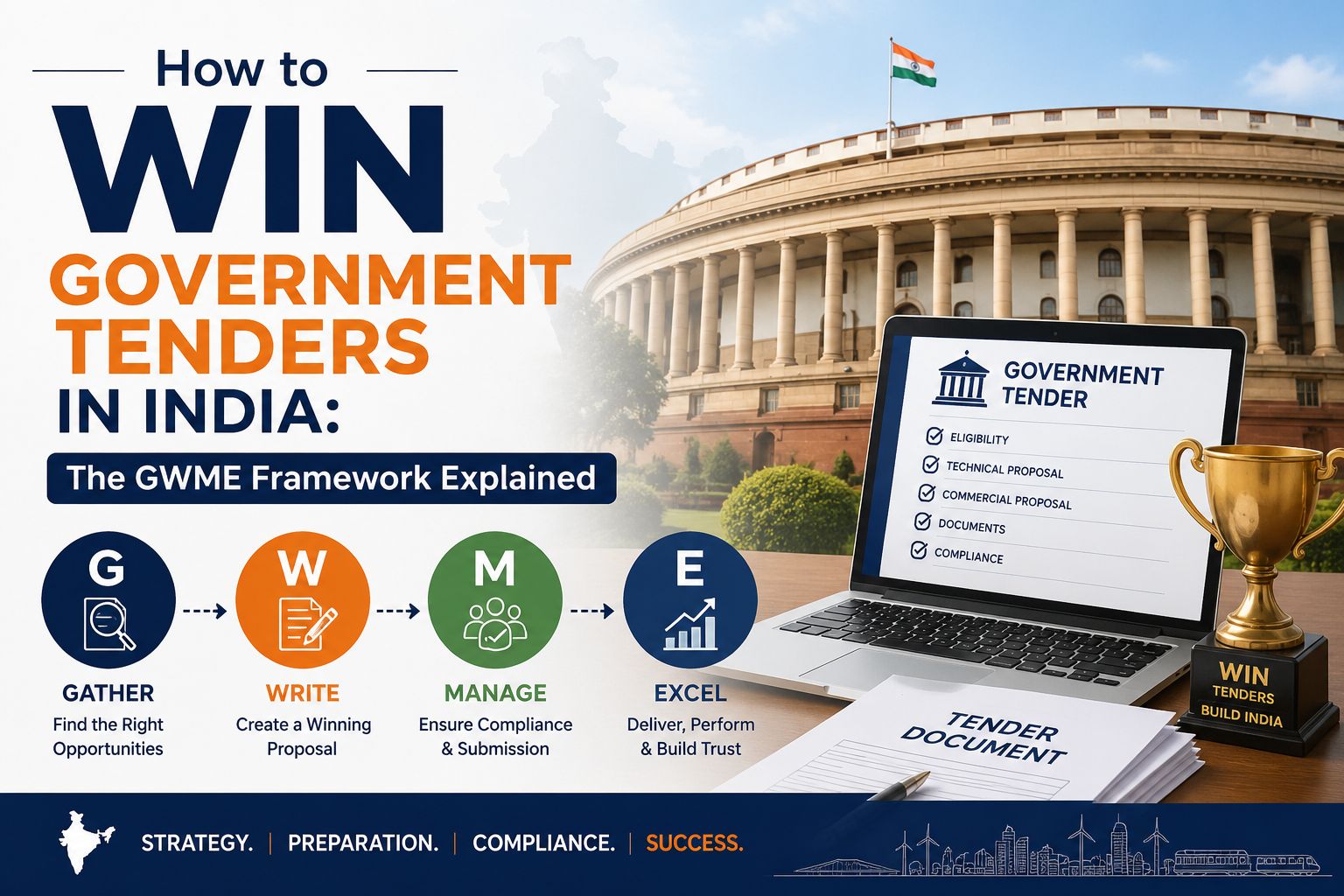
This is the scaling pathway that Dr. Siya Seth's GWME programs are designed to take you through — from your first GeM order to building a ₹50–₹100 Cr government business.
Conclusion: GeM Is a System, Not a Lucky Draw
Every day, thousands of orders are placed on GeM across every category imaginable. The businesses winning them aren't the biggest — they're the best-prepared.
Get registered, get compliant, categorise correctly, bid strategically, and execute flawlessly. That is the GeM formula.
Want expert guidance on your GeM strategy? Dr. Siya Seth's GWME programs at GWMEindia.com have helped 500+ businesses crack their first government contract.